Uncovered Self-Expanding Metal Stent Placement for Unresectable Malignant Biliary Obstruction: Hope or Hype?
Abstract
Background
Biliary drainage is recommended for unresectable malignant Extrahepatic Biliary Obstruction (EHBO) to palliate jaundice, pruritus, and cholangitis. However, real-world evidence from India regarding uncovered Self-Expanding Metal Stents (SEMS) remains limited.
Methods
This single-center retrospective analysis evaluated prospectively collected clinical data from GB Pant Hospital, New Delhi. Patients with biopsy-proven unresectable malignant EHBO (Bismuth Types I–III and distal obstruction) who underwent uncovered biliary SEMS placement between September 2023 and December 2024 were included. Patients were followed every two weeks until March 13, 2025, or death. The primary endpoint was 3-month stent patency, while secondary endpoints included clinical success at 2 weeks, 6-month survival, and procedure-related adverse events.
Results
Forty-nine patients were included, with gallbladder carcinoma accounting for 67% of cases. Technical success was achieved in all patients (100%), while clinical success reached 86%. Procedure-related adverse events occurred in five patients, including perforation, post-sphincterotomy bleeding, and aspiration pneumonia. Two procedure-related deaths were reported. Only 24% of patients received chemotherapy after stent placement. Median survival was 89 days, with only 20.7% surviving beyond six months, while most deaths resulted from disease progression.
Conclusion
Uncovered SEMS demonstrated excellent technical success and acceptable short-term clinical outcomes. However, the high six-month mortality rate, largely due to aggressive gallbladder cancer and limited access to chemotherapy, may reduce the long-term clinical advantage of SEMS over plastic stents in healthcare settings with limited palliative oncology services.
Keywords:
Uncovered SEMS; Biliary cancer; Cholangitis; Jaundice; Pruritus
Introduction
Biliary drainage is indicated for unresectable malignant Extrahepatic Biliary Obstruction (EHBO) to palliate jaundice and pruritus. The use of biliary Self-Expanding Metal Stents (SEMS) in unresectable EHBO is increasing; however, data on the safety and efficacy of uncovered biliary SEMS in India remains limited. The study aimed to assess whether uncovered SEMS are associated with meaningful improvements in stent patency, complication.
Methodology
This study is a single-center retrospective analysis of prospectively collected data from September 1st, 2023, to December 31st, 2024, at the GB Pant Hospital, New Delhi. Patients with unresectable biopsy-proven malignant EHBO with Bismuth classification types 1,2,3, and distal biliary obstruction were included. Covered SEMS and SEMS placed for benign causes of extrahepatic biliary obstruction during the study period were excluded (Figure 1A). The Institutional Ethics Committee granted a waiver of ethical clearance considering the retrospective nature of the study.
The patients were admitted pre-procedure and received IV antibiotics on admission. ERCP indications included prechemotherapy palliation of jaundice, pruritus, and cholangitis. The procedure was performed using a standard duodenoscope (TJF-Q190V Duodenoscope, Olympus®, Tokyo, Japan) After successful biliary cannulation, bile aspiration and air cholangiography were performed to confirm the position, and endoscopic sphincterotomy was performed. EGISTM (S&G Biotech Inc., Gyeonggi-do, Republic of Korea) single bare metallic SEMSs were placed in all patients, with 10 mm diameter and 8 cm or 10 cm length stents, except for the Bismuth Type 3 block, where bilateral SEMS were placed (Figure 1B-1D). Complications were managed according to standard protocols. Patients were referred for chemotherapy after successful ERCP stenting and followed up biweekly for complications until March 13th, 2025, or mortality.
The primary outcome of this study was the frequency of stent patency at 3 months. Secondary outcomes included clinical success at 2 weeks, overall survival at 6 months, and adverse events. Various study definitions and definitions of complications are provided in Supplementary Table 1.
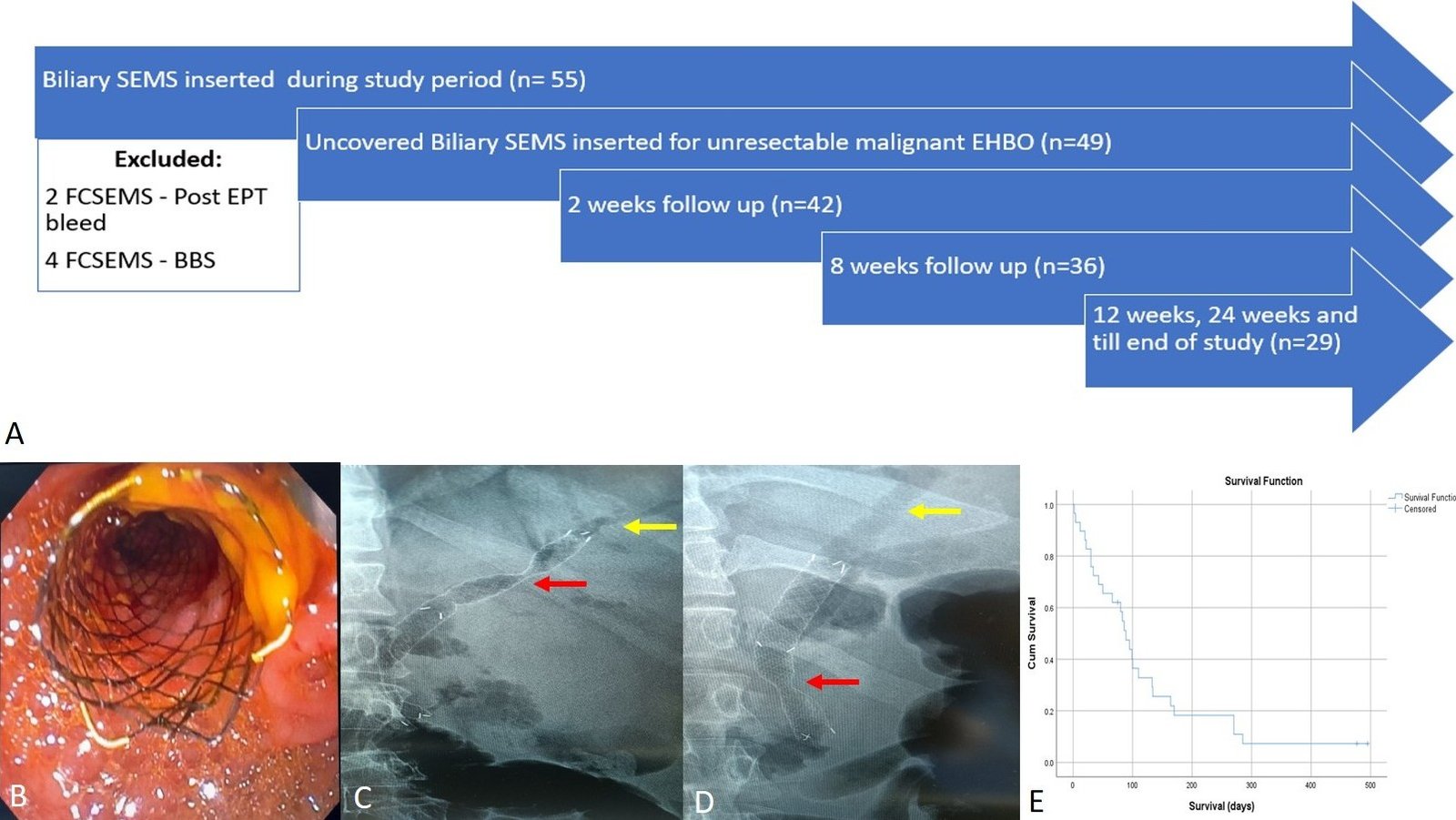
Figure 1:
(A) shows the study flow chart and follow-up of patients; (B) endo- scopic view of the distal end of the uncovered biliary SEMS; (C) abdominal ra- diograph image showing biliary SEMS in position placed for hilar stricture (red arrow) with pneumobilia (yellow arrow); (D) abdominal radiograph image showing biliary SEMS in position placed for distal stricture (red arrow) with pneumobilia (yellow arrow); (E) Kaplan Meier curve showing survival of pa- tients with malignant EHBO after placement of biliary SEMS (median survival time, 89 days).| Parameter | n = 49 |
|---|---|
| Demographic Data | |
| Age, yrs, mean (SD) | 54.24 ± 12.6 |
| Sex, male, n (%) | 25 (51%) |
| Comorbidities | |
| Hypertension | 7 (14.2%) |
| Diabetes | 5 (10.2%) |
| Disease Characteristics | |
| Etiology | |
| Carcinoma Gall Bladder | 33 (67.3%) |
| Carcinoma of the Head of the Pancreas | 6 (12.2%) |
| Cholangiocarcinoma | 6 (12.2%) |
| Periampullary Carcinoma | 4 (8.2%) |
| ECOG Status | |
| 1 | 6 (12.2%) |
| 2 | 41 (83.6%) |
| 3 | 2 (4.1%) |
| Hematological and Biochemical Parameters (Mean ± SD) | |
| Haemoglobin (g/dL) | 10.4 ± 1.6 |
| Total Leucocyte Count (cells/uL) | 12128 ± 7020 |
| Platelets (cells/uL) | 304936 ± 131733 |
| Total Bilirubin (mg/dL) | 14.3 ± 6.9 |
| Aspartate Transaminase (U/L) | 119.6 ± 69.5 |
| Alanine Transaminase (U/L) | 70.2 ± 34.0 |
| Alkaline Phosphatase (U/L) | 759.9 ± 582.8 |
| International Normalised Ratio | 1.12 ± 0.43 |
| Blood Urea (mg/dL) | 35.61 ± 31.81 |
| Serum Creatinine (mg/dL) | 0.87 ± 0.47 |
| Total Protein (g/dL) | 6.5 ± 0.82 |
| Serum Albumin (g/dL) | 2.89 ± 0.6 |
| Level of Block Based on MRCP Findings | |
| Hilar Block as per Bismuth-Corlette Classification | |
| Type 1 | 9 (18.4%) |
| Type 2 | 19 (38.8%) |
| Type 3 | 10 (20.4%) |
| Distal Block | 11 (22.4%) |
| Indications for Stenting | |
| Pre-chemotherapy | 18 (36.7%) |
| Pruritus | 5 (10.2%) |
| Both | 26 (53.1%) |
| Stent Characteristics | |
| Single SEMS | 39 |
| Bilateral SEMS | 10 |
| Length of Stent (cm); Mean (SD) | 9 ± 1.09 |
cm: centimeters; ECOG: Eastern Cooperative Oncology Group; MRCP: Magnetic Resonance Cholangiopancreatography; SD: Standard Deviation; SEMS: Self-Expandable Metal Stent
Statistical analysis
Data were entered into an MS Excel spreadsheet, and statistical analysis was performed using SPSS v. 25. Categorical data were expressed as frequencies and percentages. Continuous data was expressed as mean +/standard deviation for normal distribution and median +/IQR for skewed distribution. Kaplan Meier analysis was used to assess survival and stent patency. Cox regression analysis was done for various predictors of survival and stent patency. p<0.05 was considered statistically significant.
Results
This study included 49 patients with biopsy-proven malignant EHBO who underwent placement of uncovered biliary SEMS. The most common malignancy was gallbladder carcinoma (67%). Baseline characteristics are shown in Table 1. Technical and clinical success rates were 100% and 86%, respectively.
The median stent patency could not be reached owing to high mortality before stent placement. Three patients had developed stent block, with two managed by placement of plastic stents and one by another SEMS. ERCP-related complications occurred in five patients: Three perforations (two managed conservatively and one surgically), one post-sphincterotomy bleeding, and one aspiration pneumonia post-ERCP. Of these five patients, one with aspiration pneumonia and one who underwent surgery for perforation had succumbed to the respective complication. Chemotherapy was initiated only in 24% of patients after biliary SEMS placement. The median survival was 89 days, with six of 29 (20.7%) patients still alive at the 6-month follow-up. Most deaths occurred due to disease progression. This is shown in the Kaplan–Meier survival analysis in Figure 1E.
On univariable analysis, none of the evaluated factors demonstrated a significant association with stent patency or overall survival (Tables 2 and 3). Consequently, multivariable analysis was not performed, as no variables met criteria for inclusion based on univariable results.
| Parameter | HR | Lower CI | Upper CI | p value |
|---|---|---|---|---|
| Age >50 years | 0.022 | 0.000 | 386322.378 | 0.655 |
| Male sex | 297.491 | 0.000 | 455100686635.310 | 0.598 |
| Comorbidities present | 33.552 | 0.000 | 3690760904.748 | 0.710 |
| Etiology: | ||||
| CaGB | 1.612 | 0.093 | 27.911 | 0.743 |
| CaHOP | 24.045 | 0.000 | 17700294263592.918 | 0.820 |
| PACA | 0.354 | 0.015 | 8.291 | 0.518 |
| Cholangiocarcinoma | 21.902 | 0.000 | 644731834710147070.000 | 0.873 |
| ECOG prior to stenting | 50.075 | 0.000 | 19637714.587 | 0.551 |
| Non-hilar (distal) block | 0.798 | 0.049 | 12.982 | 0.874 |
| Distant metastasis present | 0.019 | 0.000 | 209992.700 | 0.631 |
| Number of SEMS placed | 24.045 | 0.000 | 17700294263593.105 | 0.820 |
| Length of stent (cm) | 0.893 | 0.221 | 3.603 | 0.874 |
| Complications occurred | 21.902 | 0.000 | 644731834710174590.000 | 0.873 |
| Stent obstruction | 0.038 | 0.000 | 292628903.407 | 0.778 |
| Received chemotherapy | 1.254 | 0.077 | 20.400 | 0.874 |
| Total Bilirubin (mg/dl) | 0.724 | 0.447 | 1.174 | 0.190 |
| ALP (IU/L) | 0.999 | 0.994 | 1.004 | 0.829 |
| INR | 0.172 | 0.000 | 400.246 | 0.656 |
| Parameter | HR | Lower CI | Upper CI | p value |
|---|---|---|---|---|
| Age >50 years | 0.531 | 0.225 | 1.253 | 0.149 |
| Male sex | 2.094 | 0.895 | 4.898 | 0.088 |
| Comorbidities present | 0.480 | 0.180 | 1.285 | 0.144 |
| Etiology: | ||||
| CaGB | 0.942 | 0.397 | 2.233 | 0.892 |
| CaHOP | 0.486 | 0.131 | 1.799 | 0.280 |
| PACA | 1.939 | 0.535 | 7.022 | 0.313 |
| Cholangiocarcinoma | 0.872 | 0.201 | 3.773 | 0.854 |
| ECOG prior to stenting | 0.475 | 0.204 | 1.110 | 0.085 |
| Non-hilar (distal) block | 1.025 | 0.455 | 2.309 | 0.953 |
| Distant metastasis present | 0.630 | 0.270 | 1.467 | 0.284 |
| Number of SEMS placed | 0.40 | 0.138 | 1.162 | 0.092 |
| Length of stent (cm) | 1.118 | 0.742 | 1.685 | 0.594 |
| Complications occurred | 0.214 | 0.073 | 0.626 | 0.070 |
| Received chemotherapy | 0.446 | 0.166 | 1.199 | 0.110 |
| Total Bilirubin (mg/dl) | 1.005 | 0.945 | 1.069 | 0.873 |
| ALP (IU/L) | 1.000 | 1.000 | 1.001 | 0.258 |
| INR | 4.456 | 1.433 | 13.856 | 0.100 |
Discussion
This study describes a real-world scenario involving patients with unresectable malignant EHBO. The etiology of malignant EHBO was similar to that reported in previous studies from northern India [1,2]. Most patients had an ECOG performance status ≤ 2 (95.8%) at the time of SEMS placement, indicating that they were eligible for chemotherapy [3-5]. However, only 24% of patients received chemotherapy, which is possible due to the denial of chemotherapy, poor socioeconomic status, and rapid progression of the disease before the bilirubin level reached a suitable level for chemotherapy.
The high mortality rate (80 %) in this study can be attributed to the lack of chemotherapy and the predominance of rapidly progressive GB carcinoma. A meta-analysis revealed that plastic stents had a median patency of 36 days to 173 days, whereas metallic stents had a median patency of 76 to 276 days [6]. The European Society of Gastrointestinal Endoscopy recommends SEMS for malignant EHBO [7]. A study in Jaipur reported a mean stent patency of 109 days for unresectable malignant EHBO, with greater efficacy in distal strictures than in hilar strictures [8]. Owing to the high mortality rate, median stent patency could not be achieved. While SEMS placement was effective for biliary decompression, survival outcomes were primarily influenced by advanced malignancy and limited treatment options.
None of the factors on showed a significant association with survival or stent patency univariable analysis. This may be attributable to the relatively small sample size, high attrition rate, and predominance of advanced, aggressive malignancies with poor overall survival, which could have limited the ability to detect statistically significant differences between subgroups.
The choice between covered and uncovered SEMS in malignant EHBO also remains controversial. Several meta-analyses have demonstrated no consistent superiority of covered SEMS over uncovered SEMS with respect to overall stent patency or patient survival. Almadi et al. reported in their meta-analysis with 1061 patients that although covered SEMS reduced tumor ingrowth, they were associated with significantly higher migration rates and did not demonstrate clear long-term patency benefits compared with uncovered SEMS [6]. Similarly, Li et al., in a meta-analysis of 14 trials involving 1417 patients, found no significant differences between covered and uncovered SEMS regarding cumulative stent patency, survival, or overall complication rates. They found that tumor ingrowth was more common with uncovered SEMS compared with more tumor overgrowth in covered SEMS as the cause for loss of stent patency [9]. Randomized studies have also shown conflicting findings, with some reporting longer patency for uncovered SEMS due to lower migration rates compared to covered SEMS (541 days vs 240 days) [10], whereas others demonstrated reduced tumor ingrowth with covered SEMS but without improvement in survival outcomes [11].
While uncovered SEMS are generally considered more cost- effective because of longer patency and fewer reinterventions, this advantage is most relevant in patients with an expected survival beyond 3 months. In our cohort, the high early mortality likely attenuated the practical benefit of prolonged stent patency, underscoring the need to individualize stent selection according to anticipated survival and feasibility of repeat interventions [12].
A major limitation of the present study was the high attrition rate, with approximately 40.8% of patients lost to follow-up. Given the retrospective design, outcome assessment depended on the availability of hospital records and follow-up documentation, which may have contributed to incomplete long-term data capture. In addition, many patients had advanced malignancy, belonged to lower socioeconomic strata, and were referred from distant regions, making continued follow-up challenging. This may have introduced follow-up bias and affected the assessment of long-term outcomes such as stent patency, reintervention rates, and survival. Patients lost to follow-up may have undergone subsequent interventions or experienced disease progression or death outside our institution. Therefore, the long-term efficacy outcomes should be interpreted with caution. At the same time, the high attrition rate reflects the practical difficulties of maintaining longitudinal follow-up in patients with advanced hepatobiliary malignancies in resource-limited settings.
Conclusion
SEMS placement appears to be a safe and effective modality for palliation of malignant EHBO, providing biliary decompression and symptomatic relief in patients with unresectable disease. However, the high six-month mortality rate (~80%) underscores the aggressive underlying disease biology and limited impact of currently available palliative chemoradiotherapy on overall survival. Therefore, the potential advantages of metallic over plastic stents should be interpreted within the framework of expected survival and individual patient prognosis.
Declaration
Ethical Approval and Consent to participate – Waived in view of retrospective data analysis
Human Ethics - NA
Consent for publication - Written consent taken from all patients
Authors’ Contributions
Venkatesh Vaithiyam, Barjesh Chander Sharma, Ashok Dalal, and Siddharth Srivastava are involved in the patient’s care and data collection. Siddharth Srivastava, Lalit Chandra Kummetha, Ujjwal Sonika and Venkatesh Vaithiyam - conceptualization and original draft of manuscript, Siddharth Srivastava, Sanjeev Sachdeva - Supervision and final review of the manuscript.
References
- Binda C, Trebbi M, Coluccio C, Giuffrida P, Perini B, Gibiino G, et al. Endoscopic management of malignant biliary obstructions. Ann Gastroenterol. 2024;37(3):291-302. PMC ↗
- Dutta U, Bush N, Kalsi D, Popli P, Kapoor VK. Epidemiology of gallbladder cancer in India. Chin Clin Oncol. 2019;8(4):33. PubMed ↗
- Boulay BR, Birg A. Malignant biliary obstruction: From palliation to treatment. World J Gastrointest Oncol. 2016;8(6):498. PubMed ↗
- Thol F, Gairing SJ, Czauderna C, Thomaidis T, Gamstätter T, Huber Y, et al. Outcomes in patients receiving palliative chemotherapy for advanced biliary tract cancer. JHEP Rep. 2022;4(3):100417. PMC ↗
- Taghizadeh H, Dong Y, Gruenberger T, Prager GW. Perioperative and palliative systemic treatments for biliary tract cancer. Ther Adv Med Oncol. 2024;16:17588359241230756. PubMed ↗
- Almadi MA, Barkun A, Martel M. Plastic vs. self-expandable metal stents for palliation in malignant biliary obstruction: A series of meta-analyses. Am J Gastroenterol. 2017;112(2):260-73. PubMed ↗
- Dumonceau JM, Tringali A, Papanikolaou I, Blero D, Mangiavillano B, Schmidt A, et al. Endoscopic biliary stenting: Indications, choice of stents, and results: European Society of Gastrointestinal Endoscopy (ESGE) Clinical Guideline – Updated October 2017. Endoscopy. 2018;50(09):910-30. PubMed ↗
- Gupta A, Gupta GK, Gawande A, Kumar M, Tak V, Pokharna RK, et al. Self-expanding metallic stents in malignant biliary obstruction-patency and clinical efficacy: A prospective study from North India tertiary center. J Dig Endosc. 2019;10(01):033-8. DOI ↗
- Li J, Li T, Sun P, Yu Q, Wang K, Chang W, et al. Covered versus uncovered self-expandable metal stents for managing malignant distal biliary obstruction: A meta-analysis. PLoS One. 2016;11:e0149066. PubMed ↗
- Conio M, Mangiavillano B, Caruso A, Filiberti RA, Baron TH, De Luca L, et al. Covered versus uncovered self-expandable metal stent for palliation of primary malignant extrahepatic biliary strictures: A randomized multicenter study. Gastrointest Endosc. 2018;88(2):283-91. PubMed ↗
- Yang MJ, Kim JH, Yoo BM, Hwang JC, Yoo JH, Lee KS, et al. Partially covered versus uncovered self-expandable nitinol stents with anti-migration properties for the palliation of malignant distal biliary obstruction: A randomized controlled trial. Scand J Gastroenterol. 2015;50(12):1490-9. PubMed ↗
- Bor R, Fábián A, Szűcs M, Bálint A, Rutka M, Tóth T, et al. Comparison of therapeutic efficacy and treatment costs of self- expandable metal stents and plastic stents for management of malignant biliary obstruction. BMC Gastroenterol. 2023;23(1):41. PubMed ↗
| Technical Success | |
| Distal block | Successful placement of biliary SEMS with proximal end above the level of block, with free flow of bile. |
| Hilar block | Successful placement of biliary SEMS with proximal end above the level of block in both right and left systems, with free flow of bile. |
| Clinical Success | A fall in bilirubin by >50% from baseline 2 weeks after SEMS placement. |
| Complication | |
| Post ERCP Perforation | Defined and classified as by Stapfer et al., 2000. |
| Post ERCP Pancreatitis | New or worsened abdominal pain combined with elevated pancreatic enzymes (amylase or lipase ≥ 3 times upper limit of normal), thus prolonging a planned hospital admission or necessitating hospitalization after an ERCP. |
| Post-ERCP Sphincterotomy Bleeding | Immediate bleeding requiring endoscopic or other intervention within 24 hr, or delayed bleeding recognised based on clinical evidence (such as melena, haematochezia, and hematemesis), with a decrease in haemoglobin level >2 g/dL or the need for blood transfusion within 10 days after ERCP. |
| Cholangitis | Defined as per the Tokyo criteria, TG18. |