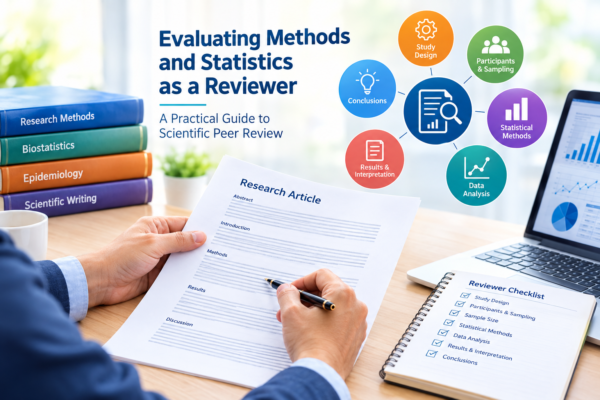
Evaluating Methods and Statistics as a Reviewer: A Practical Guide to Scientific Peer Review
Scientific peer review plays a vital role in maintaining the quality, accuracy, and credibility of academic research. One of the most important responsibilities of a peer reviewer is to evaluate whether a manuscript’s research methods and statistical analyses are appropriate, reliable, and sufficient to support its conclusions.
A manuscript may present interesting findings and well-written arguments, but its scientific value depends on the quality of the research design, the accuracy of the analysis, and the interpretation of the evidence.
Evaluating research methods and statistics as a reviewer requires more than checking whether statistical tests have been performed. Reviewers must understand the research question, examine how the data were collected, assess the appropriateness of the statistical methods, and determine whether the conclusions are justified.
In this blog, we explore practical strategies for evaluating research methodology and statistical analysis during peer review, helping researchers develop stronger manuscript assessment skills and contribute to responsible scientific publishing.
Why Are Research Methods and Statistics Important in Peer Review?
Research methods determine how scientific evidence is collected, while statistical analysis helps researchers interpret that evidence.
If the study design is inappropriate or the statistical methods are incorrectly applied, the findings may be misleading, even when the manuscript appears scientifically convincing.
A reviewer’s evaluation helps identify methodological weaknesses, statistical errors, and unsupported interpretations before a manuscript is accepted for publication.
A thorough assessment can help:
Improve the scientific validity of research findings.
Identify potential bias and limitations in study design.
Detect inappropriate statistical tests or interpretations.
Ensure that conclusions are supported by the available evidence.
Improve the transparency and reproducibility of scientific research.
Step 1: Understand the Research Question and Study Design
Before examining statistical calculations, reviewers should understand what the researchers intended to investigate.
Start by reading the title, abstract, and research objectives. Identify the primary research question and determine whether the selected study design is appropriate for answering it.
Different research questions require different study designs.
For example:
Research objective
Commonly appropriate study design
Investigate the effectiveness of an intervention
Randomized controlled trial
Examine associations between exposures and outcomes
Observational study
Estimate the prevalence of a condition
Cross-sectional study
Investigate a rare or unusual clinical presentation
Case report or case series
Combine evidence from multiple studies
Systematic review or meta-analysis
Reviewers should assess whether the authors have clearly described the study design and justified its selection.
A major concern arises when the research design cannot adequately answer the stated research question.
Step 2: Evaluate the Study Population and Sampling Methods
The quality of research findings depends partly on how participants or observations were selected.
Reviewers should examine the study population, sampling strategy, inclusion criteria, exclusion criteria, and recruitment procedures.
Important questions include:
Is the target population clearly defined?
Are the inclusion and exclusion criteria appropriate?
Is the sampling method suitable for the research objective?
Could the selection process introduce bias?
Are the characteristics of the participants adequately reported?
Are there important differences between the study population and the population to which the findings are applied?
For example, a study conducted in a highly selected patient population may not provide sufficient evidence for conclusions about a broader population.
Reviewers should also examine whether the authors have explained how missing data, participant withdrawals, or exclusions were handled.
Step 3: Assess Sample Size and Statistical Power
Sample size is an important consideration when evaluating quantitative research.
An insufficient sample size may reduce the ability of a study to detect an effect, while an inadequately justified sample size may raise questions about the reliability of the findings.
Reviewers should determine whether the authors have provided an appropriate sample size calculation or justification.
For studies involving statistical hypothesis testing, this may include:
The expected effect size.
The selected significance level.
The desired statistical power.
The assumptions used in the calculation.
The expected dropout or missing-data rate.
A study with a small sample size is not automatically poor quality. However, reviewers should consider whether the available data are sufficient to support the intended analysis and the strength of the conclusions.
Similarly, a large sample size does not guarantee high-quality research if the study design or statistical methods are inappropriate.
Step 4: Examine the Statistical Methods
One of the central responsibilities of a reviewer is to determine whether the statistical methods are suitable for the research question, study design, and type of data.
Reviewers do not necessarily need to reproduce every statistical calculation. However, they should understand the purpose of the methods used and recognize when specialist statistical expertise may be required.
Descriptive statistics
Descriptive statistics summarize the characteristics of a study population or dataset.
Common examples include:
Mean and standard deviation for appropriate continuous data.
Median and interquartile range for skewed or ordinal data.
Frequencies and percentages for categorical data.
Reviewers should assess whether the selected summaries accurately represent the data.
For example, reporting only the mean for highly skewed data may provide an incomplete picture of the distribution.
Inferential statistics
Inferential statistics are used to draw conclusions about a population based on sample data.
Common methods include t-tests, chi-square tests, analysis of variance, regression models, and other statistical procedures.
The reviewer should examine whether the selected test is appropriate for:
The research question and hypothesis.
The type and distribution of the data.
The number of groups being compared.
The study design and independence of observations.
The assumptions required by the statistical method.
A statistical test should not be considered appropriate simply because it is commonly used in published research.
Regression and adjusted analyses
Regression models are frequently used to examine associations between variables while accounting for other factors.
Reviewers should assess whether the authors have explained their selection of variables and justified any adjustment for potential confounders.
They should also consider whether the model is appropriate for the outcome variable and whether the number of observations is adequate for the complexity of the analysis.
Step 5: Check Statistical Assumptions and Data Quality
Many statistical methods rely on assumptions about the data and study design.
If these assumptions are seriously violated, the results may be unreliable or difficult to interpret.
Reviewers should consider whether the authors have assessed relevant assumptions, such as:
Independence of observations.
Distributional assumptions where required.
Homogeneity of variance where relevant.
Linearity in regression models.
Multicollinearity in regression analyses.
Appropriate handling of missing data and outliers.
Not every manuscript needs to report every possible diagnostic test. The level of detail should be appropriate to the study design and analytical complexity.
However, important assumptions should be examined when their violation could materially affect the findings.
Reviewers should also assess whether data cleaning, exclusions, and transformations have been explained adequately.
Step 6: Evaluate P-Values, Confidence Intervals, and Effect Sizes
Statistical significance is frequently reported in scientific manuscripts, but it should not be the only basis for interpreting research findings.
Reviewers should examine the magnitude of the observed effect, the uncertainty around the estimate, and its practical or clinical relevance.
P-values
A p-value helps assess how compatible the observed data are with a specified statistical model under the null hypothesis.
A p-value below a selected significance threshold does not automatically establish that a finding is important, clinically meaningful, or free from bias.
Similarly, a result that does not reach statistical significance does not prove that no effect exists.
Confidence intervals
Confidence intervals provide information about the precision and uncertainty of an estimated effect.
A wide confidence interval may indicate substantial uncertainty, even when the reported p-value is statistically significant.
Reviewers should assess whether the confidence intervals are reported where appropriate and whether the interpretation reflects their width and range.
Effect sizes
Effect sizes describe the magnitude of a difference, association, or intervention effect.
Examples include mean differences, risk ratios, odds ratios, and standardized effect sizes.
A statistically significant result may have little practical importance if the effect is very small.
Reviewer tip: Evaluate the statistical significance, magnitude, precision, and practical relevance of a finding together rather than relying on a p-value alone.
Step 7: Identify Multiple Testing and Selective Reporting
When researchers conduct numerous statistical tests, the probability of obtaining apparently significant findings by chance can increase.
Reviewers should determine whether the manuscript includes multiple comparisons, subgroup analyses, or numerous outcomes that require particular consideration.
Important questions include:
Were the primary and secondary outcomes clearly identified?
Were the statistical analyses planned appropriately?
Have the authors explained how multiple comparisons were handled, where necessary?
Are subgroup analyses justified and interpreted cautiously?
Are all relevant outcomes reported transparently?
Reviewers should also consider whether the manuscript selectively emphasizes statistically significant results while giving insufficient attention to nonsignificant findings.
Selective reporting can create an incomplete or misleading picture of the research evidence.
Step 8: Compare the Statistical Results With the Conclusions
The results and conclusions should be consistent with one another.
Reviewers should compare the statistical findings reported in the results section with the interpretations presented in the discussion and conclusion.
Look for:
Incorrect interpretation of p-values.
Unsupported claims of causation.
Overstated clinical or scientific significance.
Conclusions that extend beyond the study population.
Failure to acknowledge uncertainty or important limitations.
Inconsistencies between the text, tables, and figures.
For example, an observational study may identify an association between a risk factor and a disease. However, the reviewer should question any claim that the risk factor directly caused the disease unless the study design and evidence adequately support that conclusion.
The strength of the conclusion should reflect the strength of the evidence.
Step 9: Evaluate Tables, Figures, and Statistical Reporting
Tables and figures should present the results accurately and make the findings easier to understand.
Reviewers should check whether:
Tables and figures are clearly labeled.
Sample sizes are reported appropriately.
Statistical measures and units are explained.
The reported values are consistent with the main text.
Confidence intervals and effect sizes are included where appropriate.
Statistical significance is presented accurately.
Figures do not exaggerate differences or obscure uncertainty.
Reviewers should also assess whether the statistical methods are described sufficiently for readers to understand how the reported results were obtained.
When important analytical details are missing, the reviewer should request clarification rather than assume that the analysis was performed correctly.
Step 10: Recognize When Statistical Expertise Is Needed
Not every peer reviewer is expected to be an expert in every statistical method.
Some manuscripts involve complex analyses, including advanced regression models, survival analysis, Bayesian statistics, machine learning, or meta-analysis.
When the statistical methods are beyond the reviewer’s expertise, it is appropriate to recommend an additional statistical review.
A reviewer should clearly identify the area of concern and explain why specialist assessment may be necessary.
Seeking statistical expertise is a responsible step that helps protect the scientific quality of the publication process.
By administrator
