Why Are Figures, Tables, and Data Important in Peer Review?
-
By administrator
- In Zenith Publications
Figures and tables are not merely visual additions to a research article. They represent the evidence on which scientific interpretations are based. A peer reviewer should evaluate whether: Figures accurately represent the results described in the manuscript. Tables present numerical information clearly and consistently. Statistical analyses are appropriate for the study design. Data interpretation is […]
Read More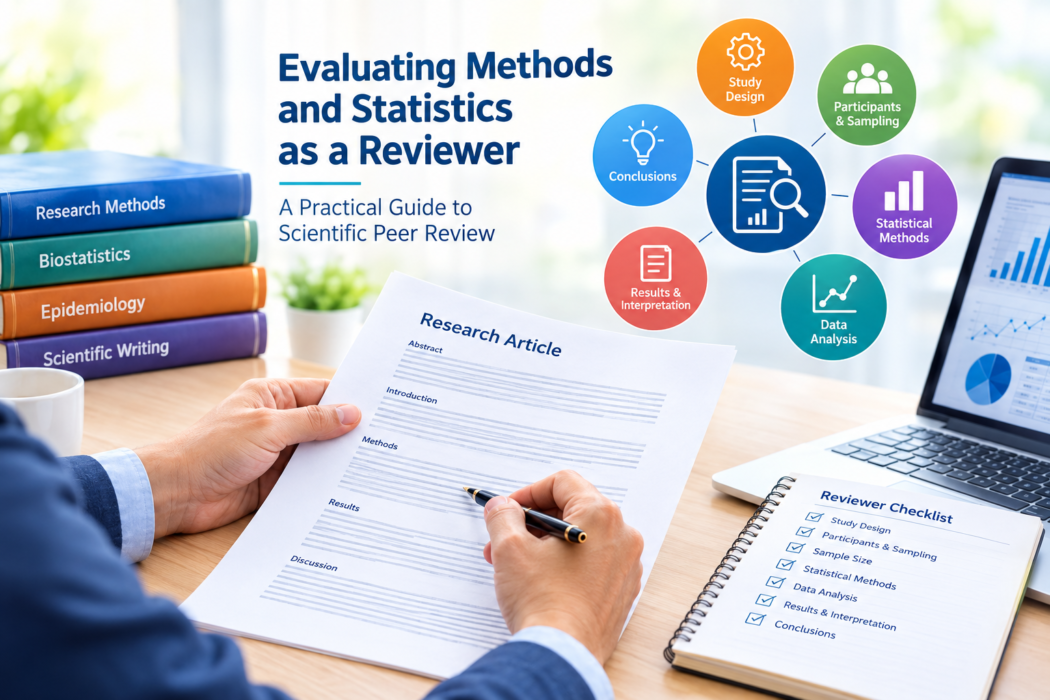
Evaluating Methods and Statistics as a Reviewer: A Practical Guide to Scientific Peer Review
-
- In Zenith Publications
Scientific peer review plays a vital role in maintaining the quality, accuracy, and credibility of academic research. One of the most important responsibilities of a peer reviewer is to evaluate whether a manuscript’s research methods and statistical analyses are appropriate, reliable, and sufficient to support its conclusions. A manuscript may present interesting findings and well-written […]
Read More
How to Critically Read a Manuscript: A Step-by-Step Guide for Researchers
-
- In Zenith Publications
Reading a scientific manuscript is more than understanding its content. Researchers must learn to evaluate the quality of evidence, examine the strength of arguments, and determine whether the conclusions are supported by the findings. Critical reading of a manuscript is an essential skill for researchers, postgraduate students, clinicians, and academic professionals. It helps readers identify […]
Read More
Use AI in Research Without Risking Your Publication
-
- In Zenith Publications
You might be using an AI tool to clean up your grammar or summarize a long paper right now. Most researchers are. But while the tools are everywhere, the rules are not. Many authors feel a growing sense of dread when they hit the submit button. They worry that a tool they used for basic […]
Read More
Get Your Paper Past the Technical Check for Faster Publication
-
- In Zenith Publications
Many authors think a great study is all they need to get published. They spend months on the science but minutes on the upload. Now, that approach leads to quick rejections. Journals use automated tools to scan files before a human editor ever sees the work. If your file is the wrong type or your […]
Read More
Protect Your Research Rights in the Era of Data-Driven Scholarly Publishing
-
- In Zenith Publications
Your research paper is no longer just a document. For years, the PDF was the gold standard for sharing academic work. It kept things static and safe. But things have changed. Now, publishers treat your articles as sets of structured data. They break your work into pieces to be mined, sorted, and reused. This shift […]
Read More
Increase Your Acceptance Rate by Fixing These 5 Clinical Paper Rejection Reasons
-
- In Zenith Publications
Why do most clinical papers get rejected? It isn’t always about bad data. Many doctors and researchers spend months on a study only to get a desk rejection in ten minutes. This happens because editors see the same mistakes over and over. Data from editor comments and journal analyses between 2001 and 2024 show a […]
Read More
Get Your Paper Published Faster by Understanding AI in Academic Publishing
-
- In Zenith Publications
Does your manuscript get rejected before a human even reads it? Many authors face “desk rejection” without knowing why. The answer often lies in the first stage of the review process, where software now acts as the first gatekeeper. AI is changing how journals handle papers. It doesn’t replace the experts, but it changes how […]
Read More
Stop Your Research from Being Flagged During Clinical Paper Integrity Checks
-
- In Zenith Publications
The STM Integrity Hub screens over 125,000 manuscripts every month. They catch about 1,000 suspected paper mill submissions a month before a human editor even sees them. Many authors think their paper will only be judged on the science, but journals now run integrity checks first. This means your work could be rejected or delayed […]
Read More
Secure Your Peer Review with a Strong Research Methodology
-
- In Zenith Publications
Many researchers find their papers rejected not because the topic is boring, but because the study design is broken. You can have a groundbreaking idea, but if your methods can’t support your claims, editors will send it back. Analysis of rejected manuscripts shows that a mismatch between the research question and the design is a […]
Read More