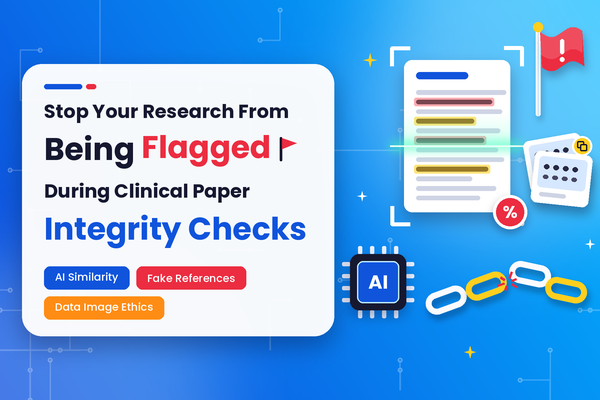
Stop Your Research from Being Flagged During Clinical Paper Integrity Checks
The STM Integrity Hub screens over 125,000 manuscripts every month. They catch about 1,000 suspected paper mill submissions a month before a human editor even sees them. Many authors think their paper will only be judged on the science, but journals now run integrity checks first. This means your work could be rejected or delayed not because your data is wrong, but because a software flag triggered an alarm.
You can avoid these traps with a few disciplined habits. Learning how journals screen for fraud helps you protect your reputation and speed up your path to publication.
Similarity reports do not just look for plagiarism. They search for patterns. Journals use these tools to find reused blocks of text or writing that looks like it came from a template. If you use AI to write your paper, it often creates standard language that looks like thousands of other submissions. This is a major red flag for editors.
To keep your paper from looking like a template, focus on your specific context. If you have to reuse a description of a method you used in a past study, cite the original source. Do not just copy and paste. Rewrite the steps to show how they applied to this specific project.
Your discussion section should be the most original part of your work. Avoid generic statements about the importance of the field. Instead, use a clinical voice. Talk about your actual findings and what they mean for real patients. When you write with a specific clinical perspective, you move away from the generic patterns that trigger similarity flags.
Fix Citation Hallucinations and Fake References
Fabricated references are one of the fastest ways to lose an editor’s trust. They are easy for a journal to verify and almost impossible for an author to justify. AI tools are notorious for “hallucinating” citations. They create a title and a journal name that sound real, but the paper does not exist.
You should treat AI as a drafting assistant, not a source of facts. Never trust a citation provided by an AI tool without checking it yourself. This is a procedural failure that can lead to an immediate integrity escalation.
Use a strict verification process for every single reference in your list:
Search for the paper in PubMed.
Confirm the DOI through Crossref.
Visit the actual journal website to see the abstract.
Delete any reference you cannot find.
Removing a suspicious reference is better than having an editor find it. A missing citation is a minor edit; a fake citation is a breach of ethics.
Maintain Data Consistency Across Your Manuscript
Errors in your numbers can look like fraud to an editor. If a p-value changes between the abstract and the results table, it raises a red flag. If the number of excluded patients differs between the methods and the flowchart, editors wonder why. This scrutiny has increased because of mass retractions in the industry.
One example is the Journal of Intelligent and Fuzzy Systems, which retracted over 1,500 papers in a single investigation. Because of these scandals, editors now look for internal consistency as a proxy for honesty.
Keep strict records to prevent these mistakes. Save your raw data in a secure place and keep a log of every analysis step you take. Before you submit, do a manual cross-check of every number.
Create a simple checklist for your final review:
Check the abstract numbers against the results section.
Compare the table data to the text in the results.
Ensure the total sample size is the same in every section.
Clearly explain why every single patient was excluded from the study.
Follow Strict Image Ethics for Your Figures
Images are persuasive, which makes them a prime target for manipulation. Editors look for subtle signs of cheating, such as duplicated image parts or undisclosed splices. They also look for selective enhancement, where an author cleans up one part of a photo but not the rest.
The safest rule is to be conservative with your edits. Your goal is not a pretty picture, but honest evidence.
Follow these rules for all visual data:
Keep your original, unedited files.
Apply any brightness or contrast changes to the whole image, not just one area.
Label any spliced images clearly in the caption.
Avoid “cleaning up” background noise if it changes the interpretation of the data.
Transparency is more important than a perfect image. If you disclose how you processed a figure, editors are less likely to suspect foul play.
Disclose AI Use and Keep Human Accountability
Journals are moving toward total transparency regarding AI. The ICMJE recommends that journals require authors to disclose if and how they used AI during the research or writing process. Most journals now have a specific section for this disclosure at the time of submission.
It is important to remember that AI cannot be an author. It cannot take responsibility for the data or the ethics of the study. Only a human can be accountable for the work.
When you disclose AI use, be specific. Do not just say you used AI. Explain if you used it for grammar checks, brainstorming, or drafting sections. Then, state that the human authors verified every claim and reference.
To stay safe:
Clearly state your AI tools in the methods or acknowledgments.
Describe the exact role the AI played.
Sign off on the fact that you checked every AI-generated sentence for accuracy.
Take full ownership of all conclusions.
Final Thoughts on Clinical Paper Integrity
Getting a paper published requires more than good science. You have to pass the integrity screen. By avoiding templated language and verifying every citation, you remove the easiest reasons for a rejection. Keeping your data consistent and your images transparent tells the editor that your work is reliable.
The trend is moving toward more disclosure and stricter checks. If you keep raw logs, verify your references, and are honest about your AI use, you can move through the submission process without fear. Focus on transparency and human accountability to ensure your research reaches the clinical community.
By administrator
